

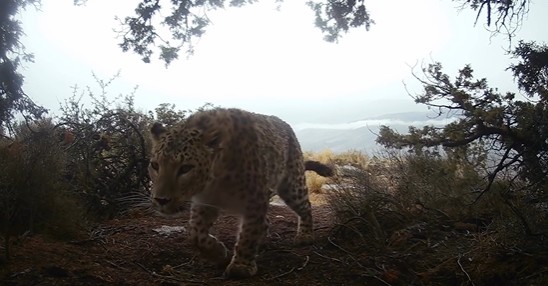
Photo: Team Bars Turkmenistan
There is a distinct feeling to checking remote camera trap data. One day you are looking at empty, rocky terrain in the Uly Balkan range or the harsh landscapes near Garabogazgöl, and the next, you catch a glimpse of a leopard moving across the frame.
For International Day for Biological Diversity, as the global community rallies around the theme of "Acting locally for global impact," this footage shows exactly how field-level conservation scales to protect the wider planet.
Why Leopards are the Ultimate Health Check for Biodiversity
Leopards are apex predators at the top of the food chain and ecologists consider them an umbrella species because protecting them also helps conserve the many species and habitats that support them. Their survival depends on the health of the entire ecosystem below them, so conserving leopards indirectly protects that broader ecosystem as well.
When a camera trap catches a leopard thriving in these remote mountains, it tells us that the mountain goats and wild sheep they hunt are abundant. It means the desert grasslands feeding those herbivores are stable, water sources are viable, and local communities are successfully coexisting with wildlife.
When we look at our latest footage, we are seeing this ecological web in action. Whether it’s a mother guiding her cub through a steep mountain pass or an adult marking a scent post, every clip provides a direct status report on the health of the entire landscape. If the apex predator survives, the whole ecosystem survives.
Scaling Conservation Tech: From Local Boots to Global Blueprints
But keeping tabs on an animal that roams across these massive, vertical ranges requires a lot of practical groundwork. Through our Central Asia Programs, we partner directly with local rangers, researchers, and communities who trek through sub-zero temperatures to deploy and maintain remote field hardware.
By capturing these moments on camera, we are gathering rich, behavioral data.
Unlike static photos, camera trap video allows us to track real-time health, territorial shifts, and behavioral responses to changing climates. But processing thousands of hours of high-resolution video in remote regions creates a massive data bottleneck.
This is where we connect local field action to scalable innovation. By running these data streams through technology like Sentinel—our smart sensing platform that uses AI to process images and video directly at the edge—our teams can rapidly translate raw insights into immediate conservation responses.
The tools, methodologies, and AI pipelines we hone on these ridges create scalable solutions that can be adapted to track and protect threatened biodiversity anywhere on Earth.
Innovation scales globally, but conservation works locally.
Acting locally generates global impact. Our local actions protect global biodiversity.
