

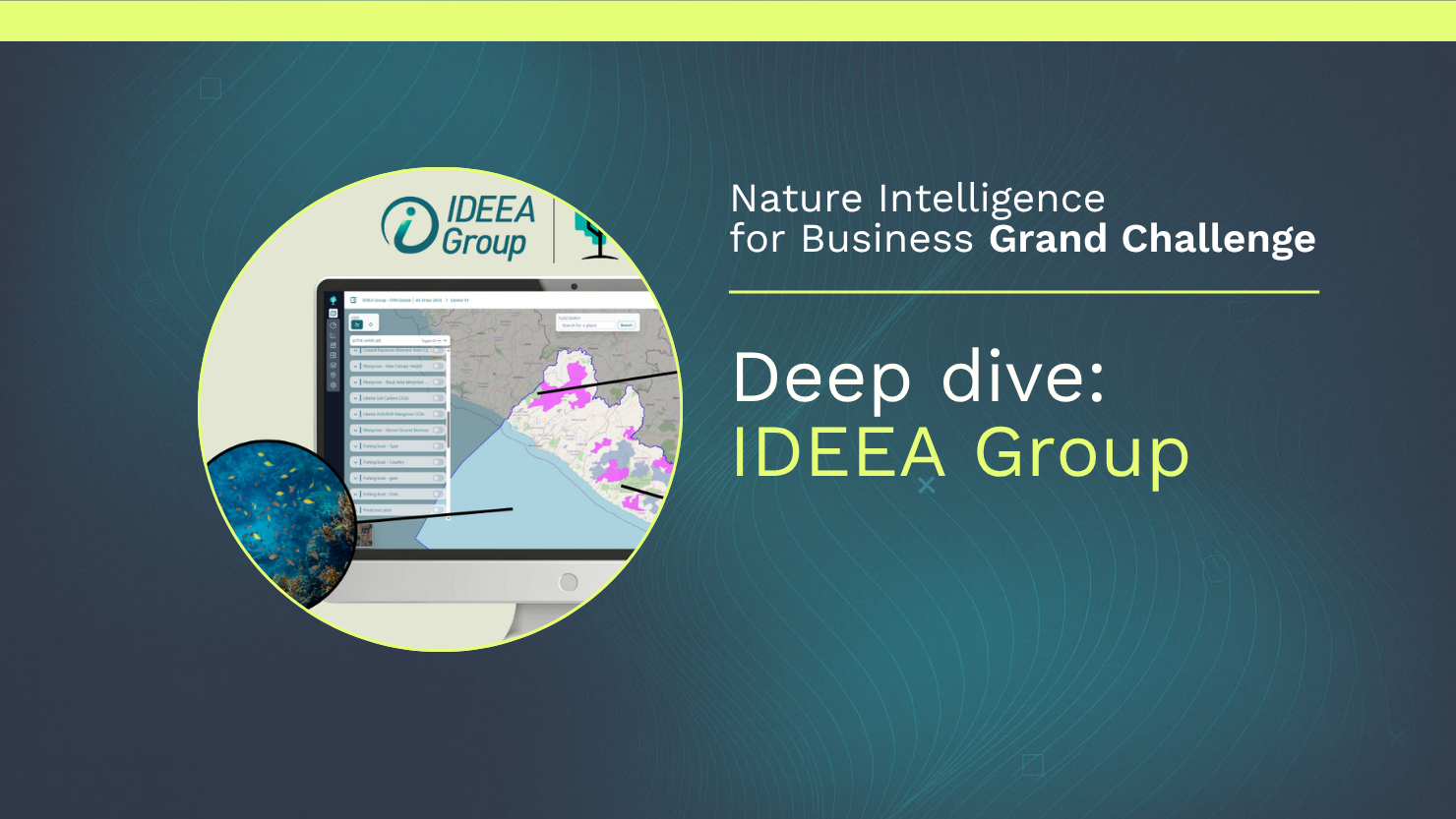
For IDEEA Group, the modern sustainability challenge isn't a scarcity of information. High-quality environmental data already exists across the globe, but it remains heavily fragmented, highly technical, and locked away behind expensive specialist consultancies. Through their platform, Data for Nature is breaking down these barriers—creating an open, adaptable infrastructure that converts raw, chaotic ecological data into structured nature intelligence that any enterprise can readily deploy.
-
The corporate conversation around biodiversity often stalls on the mistaken belief that we simply do not know enough yet to take action. This focus on data collection masks a much deeper problem: an intelligence gap. Running a business requires navigating concrete realities like operational risk, market entry, and financial stability, yet localized environmental data rarely speaks that commercial language. To move past paralyzing uncertainty, technology must stop treating data as a static hurdle and start formatting it as a transparent, dynamic framework for everyday decision-making.
The friction is particularly acute for lean enterprises attempting to align with emerging frameworks like TNFD. Under traditional models, simply identifying where physical assets intersect with sensitive ecosystems—the critical "Locate" phase—absorbs up to 80% of a company's time, budget, and operational capacity. By the time a business maps its footprint, it has little left to give to actual strategy. Flipping this ratio is the only way to transform biodiversity tracking from an administrative threat into a practical baseline for growth.
An Agnostic, Plug-and-Play Approach to the Landscape
This structural bottleneck is exactly what IDEEA Group’s platform D4N, is engineered to eliminate. Drawing on two decades of specialized expertise in natural capital accounting and geospatial analytics, the team built a platform that radically cuts down the initial friction of nature mapping. Instead of losing months to baseline site screening, the system flips the corporate effort entirely, automating the resource-heavy location mapping in a fraction of the time so that 80% of a company's focus can be preserved for understanding, planning, and executing real mitigation strategies.
What fundamentally sets D4N apart from historical environmental tools is its structural flexibility. While many legacy solutions force businesses into rigid, siloed methodologies, D4N functions as an agnostic data engine—operating much like an open spreadsheet. Whether a company is inputting highly precise local property data, private operational metrics, or global open-source satellite data, the platform accommodates the inputs seamlessly. This flexibility allows an enterprise to mix, manipulate, and update its metrics continually as new information surfaces, moving completely away from the outdated concept of the one-off consultancy report.
This structural agility becomes highly practical when applied across complex, multi-site industries like agriculture and forestry. An agricultural firm rarely operates on a single, uniform plot of land; it often manages multiple distinct properties separated by thousands of kilometers and entirely different ecological biomes. D4N allows these organizations to plug in asset footprints anywhere in the world, evaluate localized indicators consistently, and aggregate the total impact across the entire corporate portfolio. It transforms the relationship with the land from an intuitive guessing game into a repeatable, auditable corporate strategy.
The Grand Challenge Experience
IDEEA Group was selected as a finalist in the Nature Intelligence for Business Grand Challenge—a global competition convened by Conservation X Labs, the Taskforce on Nature-related Financial Disclosures (TNFD), and the United Nations Development Programme (UNDP) to find affordable, accessible nature data tools for small and medium-sized enterprises (SMEs).
For an independent innovation team, the primary barrier to driving systemic change is never a lack of technical capability—it is building market trust. In a landscape crowded with hyper-customized, short-lived software solutions, lean businesses often hesitate to invest time into new systems. For Data for Nature, the Grand Challenge provided an objective, globally recognized testing ground to validate their agnostic model against the strict, real-world cost constraints of smaller enterprises that must remain highly efficient to survive.
During the finalist evaluation phase, the team tested the D4N framework's adaptability against real commercial supply chains, proving that complex regional analysis can be executed without premium overhead costs. By showing that data can be transformed into clear, low-barrier intelligence, Data for Nature demonstrated that businesses do not need to be treated as adversarial risks, but rather as capable partners. The work of these innovators is just getting started, proving that the future of nature-positive business is already here.
